Your website loads in 8 seconds. Visitors leave before seeing your content. Google can’t crawl half your pages. You’re publishing great content, but rankings won’t improve. Sound familiar?
These aren’t content or backlink problems—they’re technical SEO issues silently destroying your search visibility. While your competitors invest in flashy marketing, they ignore the foundation that makes everything work: technical SEO.
This comprehensive guide reveals how technical SEO services transform underperforming websites into high-ranking machines. You’ll discover what technical SEO is, why it matters for Nepal-based businesses, and exactly how to fix critical technical issues holding your site back.
What Is Technical SEO and Why Does It Matter?
Technical SEO optimizes your website’s infrastructure to help search engines crawl, index, and understand your content efficiently. It focuses on the behind-the-scenes elements that affect how search engines interact with your site—not what you say, but how you say it technically.
The Technical SEO Foundation
Think of your website as a building. Content is your interior design and backlinks are your reputation in the neighborhood. Technical SEO is your foundation, plumbing, and electrical system. Without a solid foundation, your beautiful interior and great reputation mean nothing—the building collapses.
Critical Statistic: 53% of mobile users abandon sites that take longer than 3 seconds to load. In Nepal, where mobile internet penetration exceeds 85%, technical performance directly impacts your bottom line.
How Google Sees Your Website
Google sends crawlers (automated bots) to discover and analyze your website. These crawlers follow links, read code, and assess technical signals. If your site has technical issues:
- Crawlers can’t access pages → Google doesn’t know they exist
- Pages load slowly → Google ranks you lower (speed is a ranking factor)
- Site structure confuses crawlers → Google misunderstands your content hierarchy
- Mobile experience is poor → Google penalizes you (mobile-first indexing)
The Result: Your amazing content never reaches potential customers because Google can’t properly process and rank your site.
You might like this:
The Real Cost of Ignoring Technical SEO
Case Study: Kathmandu E-commerce Store
The Problem:
- Website loaded in 9 seconds on mobile
- 60% of products weren’t indexed
- Duplicate content across category pages
- No structured data implementation
The Impact:
- Organic traffic: 500 visits/month
- Conversion rate: 0.8%
- Revenue from organic: NPR 40,000/month
After Technical SEO Fix (4 Months):
- Page load time: 2.1 seconds
- 98% of products indexed
- Duplicate content resolved
- Rich snippets implemented
The Results:
- Organic traffic: 3,200 visits/month (540% increase)
- Conversion rate: 2.4% (200% increase)
- Revenue from organic: NPR 350,000/month (775% increase)
ROI: Every rupee invested in technical SEO returned NPR 12.50 within 6 months.
Why Technical Issues Are Silent Killers
Unlike content gaps or missing backlinks (which you notice), technical problems hide in your code. You keep creating content, wondering why rankings don’t improve. The real problem? Google can’t properly crawl, index, or rank your site due to technical barriers.
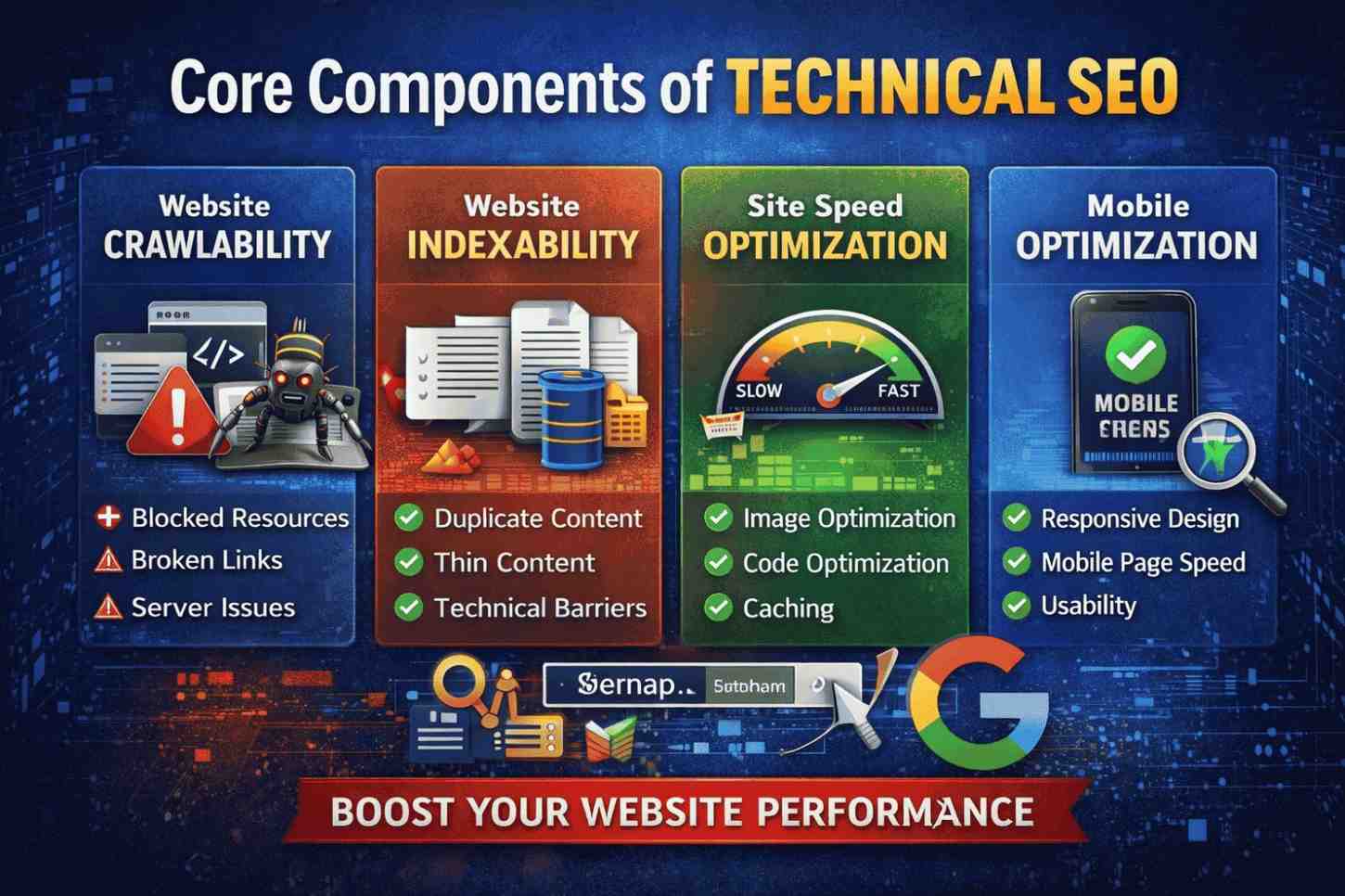
Core Components of Technical SEO
-
Website Crawlability
Crawlability determines whether search engines can access and read your website content.
Common Crawl Issues:
Blocked Resources:
- Robots.txt accidentally blocks important pages
- CSS/JavaScript files blocked (prevents proper rendering)
- Noindex tags on important pages
Broken Internal Links:
- 404 errors frustrate users and waste crawl budget
- Orphaned pages (no internal links pointing to them)
- Redirect chains (Page A → Page B → Page C)
Server Issues:
- 500 errors (server problems)
- Slow server response time
- Frequent downtime
How to Fix:
Audit Robots.txt:
User-agent: *
Allow: /
Disallow: /admin/
Disallow: /login/
Disallow: /cart/
Disallow: /checkout/
Sitemap: https://niteshbaidya.com.np/sitemap.xml
Fix Broken Links:
- Use Screaming Frog or Ahrefs to identify 404 errors
- Redirect broken URLs to relevant pages (301 redirects)
- Fix or remove broken internal links
Optimize Crawl Budget:
- Remove low-value pages from index (thin content)
- Use canonical tags to consolidate duplicate content
- Limit parameters in URLs
Pro Tip: Monitor Google Search Console’s Coverage report weekly to catch crawl issues early.
-
Website Indexability
Even if Google can crawl your pages, they might not get indexed (included in search results).
Common Indexing Problems:
Duplicate Content:
- Same content on multiple URLs
- Product pages with only image differences
- Category/tag pages with identical descriptions
Thin Content:
- Pages with minimal unique content
- Auto-generated pages
- Scraped content
Technical Barriers:
- Noindex tags accidentally applied
- Canonical tags pointing to wrong URLs
- XML sitemap issues
Solutions:
Implement Canonical Tags:
<link rel=”canonical” href=”https://niteshbaidya.com.np/technical-seo-services-nepal/” />
Create XML Sitemaps:
- List all important URLs
- Update automatically when adding pages
- Submit to Google Search Console
- Keep under 50,000 URLs per sitemap
Handle Parameters:
https://example.com/products/shoes (indexed)
https://example.com/products/shoes?sort=price (noindex)
https://example.com/products/shoes?color=red&size=10 (noindex)
Tool Recommendation: Use Google Search Console’s URL Inspection tool to diagnose specific indexing issues.
-
Site Speed Optimization
Page speed impacts both rankings and user experience. Google uses Core Web Vitals as ranking signals.
Core Web Vitals Explained:
Largest Contentful Paint (LCP):
- Measures: Loading performance
- Target: Under 2.5 seconds
- What it means: How long until main content appears
First Input Delay (FID):
- Measures: Interactivity
- Target: Under 100 milliseconds
- What it means: Time until users can interact with page
Cumulative Layout Shift (CLS):
- Measures: Visual stability
- Target: Under 0.1
- What it means: How much content shifts while loading
Speed Optimization Strategies:
Image Optimization:
- Compress images (use WebP format)
- Implement lazy loading
- Use appropriate dimensions
- Add alt text for SEO
Code Optimization:
- Minify HTML, CSS, JavaScript
- Remove unused code
- Defer non-critical JavaScript
- Use async loading for scripts
Caching:
- Browser caching (store static files locally)
- Server-side caching
- CDN implementation (Content Delivery Network)
Server Response:
- Upgrade hosting if needed
- Use quality Nepal-based hosting providers
- Enable GZIP compression
- Optimize database queries
Real-World Impact: Amazon discovered that every 100ms delay in load time costs them 1% in sales. For a Nepali e-commerce site making NPR 500,000/month, a 1-second improvement could mean NPR 50,000 additional monthly revenue.
-
Mobile Optimization
Google uses mobile-first indexing—it primarily uses your mobile site for ranking and indexing.
Mobile SEO Checklist:
Responsive Design:
- Site adapts to all screen sizes
- Touch-friendly buttons (48×48 pixels minimum)
- Readable text without zooming (16px minimum)
Mobile Page Speed:
- Target under 3 seconds load time
- Optimize images aggressively
- Minimize redirects
Mobile Usability:
- Easy navigation
- No intrusive interstitials
- Tap targets spaced properly
- Avoid horizontal scrolling
Mobile-Specific Content:
- Click-to-call phone numbers
- Location information prominent
- Simplified forms
- Mobile-friendly video formats
Testing Tools:
- Google Mobile-Friendly Test
- PageSpeed Insights (mobile score)
- Chrome DevTools mobile emulation
Nepal Context: With 85%+ mobile users and often slower connections, mobile optimization is critical for Nepal-based businesses.
-
Site Architecture & URL Structure
Logical site structure helps users and search engines navigate efficiently.
Best Practices:
Flat Architecture:
Poor Structure:
Home → Category → Subcategory → Sub-subcategory → Product (5 clicks)
Good Structure:
Home → Category → Product (3 clicks)
Clean URLs:
Bad: niteshbaidya.com.np/page?id=123&cat=5&ref=xyz
Good: niteshbaidya.com.np/technical-seo-services-nepal/
URL Guidelines:
- Use hyphens (not underscores)
- Keep URLs short and descriptive
- Include target keyword
- Use lowercase letters
- Avoid special characters
Internal Linking:
- Link from high-authority pages to important pages
- Use descriptive anchor text
- Create topic clusters (pillar + supporting content)
- Avoid orphan pages
Breadcrumbs:
Home > Services > Technical SEO Services Nepal
Benefits:
- Improves navigation
- Reduces bounce rate
- Helps Google understand structure
- Enhances user experience
-
Structured Data & Schema Markup
Structured data helps search engines understand your content context, enabling rich results.
Essential Schema Types:
Local Business:
{
“@context”: “https://schema.org”,
“@type”: “ProfessionalService”,
“name”: “Nitesh Baidya Digital Marketing”,
“image”: “https://niteshbaidya.com.np/logo.png”,
“priceRange”: “$$”,
“telephone”: “+977-981-8209722”,
“address”: {
“@type”: “PostalAddress”,
“streetAddress”: “Your Street”,
“addressLocality”: “Pātan”,
“addressRegion”: “Bagmati Province”,
“postalCode”: “44600”,
“addressCountry”: “NP”
},
“geo”: {
“@type”: “GeoCoordinates”,
“latitude”: 27.6683,
“longitude”: 85.3206
},
“openingHours”: “Mo-Fr 09:00-18:00”,
“sameAs”: [
“https://facebook.com/yourprofile”,
“https://linkedin.com/in/yourprofile”
]
}
Article/Blog Post:
{
“@context”: “https://schema.org”,
“@type”: “Article”,
“headline”: “Technical SEO Services in Nepal”,
“author”: {
“@type”: “Person”,
“name”: “Nitesh Baidya”
},
“datePublished”: “2026-01-03”,
“image”: “https://niteshbaidya.com.np/images/technical-seo.jpg”
}
FAQ Schema:
{
“@context”: “https://schema.org”,
“@type”: “FAQPage”,
“mainEntity”: [{
“@type”: “Question”,
“name”: “What is Technical SEO?”,
“acceptedAnswer”: {
“@type”: “Answer”,
“text”: “Technical SEO optimizes website infrastructure to help search engines crawl, index, and rank content efficiently.”
}
}]
}
Breadcrumb Schema:
{
“@context”: “https://schema.org”,
“@type”: “BreadcrumbList”,
“itemListElement”: [{
“@type”: “ListItem”,
“position”: 1,
“name”: “Home”,
“item”: “https://niteshbaidya.com.np”
}, {
“@type”: “ListItem”,
“position”: 2,
“name”: “Services”,
“item”: “https://niteshbaidya.com.np/services”
}, {
“@type”: “ListItem”,
“position”: 3,
“name”: “Technical SEO Services”,
“item”: “https://niteshbaidya.com.np/technical-seo-services-nepal”
}]
}
Benefits of Schema Markup:
- Rich snippets (star ratings, prices, availability)
- Enhanced search results appearance
- Higher click-through rates
- Better content understanding by Google
- Competitive advantage in SERPs
Implementation: Use Google’s Structured Data Markup Helper or plugins like Rank Math (WordPress) to add schema easily.
-
Security & HTTPS
Security isn’t optional—it’s a ranking factor and builds user trust.
Why HTTPS Matters:
- Ranking Signal: Google confirmed HTTPS as a ranking factor
- User Trust: Browsers mark HTTP sites as “Not Secure”
- Data Protection: Encrypts data between server and users
- Required for Features: Some browser features require HTTPS
Implementation Steps:
- Purchase SSL certificate (or use free Let’s Encrypt)
- Install certificate on server
- Update all internal links to HTTPS
- Set up 301 redirects from HTTP to HTTPS
- Update canonical tags
- Update XML sitemap
- Update Google Search Console property
- Check for mixed content warnings
Common Issues:
- Mixed content (HTTP resources on HTTPS pages)
- Incorrect redirects
- Certificate not covering all subdomains
- Expired certificates
Monitoring: Set up alerts for certificate expiration (usually 90 days for free certificates).
-
International & Multilingual SEO
For businesses targeting multiple countries or languages.
Hreflang Implementation:
<!– For English version in Nepal –>
<link rel=”alternate” hreflang=”en-np” href=”https://niteshbaidya.com.np/services/” />
<!– For Nepali version –>
<link rel=”alternate” hreflang=”ne-np” href=”https://niteshbaidya.com.np/ne/services/” />
<!– For default/fallback –>
<link rel=”alternate” hreflang=”x-default” href=”https://niteshbaidya.com.np/services/” />
URL Structure Options:
Country-Specific Domains:
https://niteshbaidya.com.np (Nepal)
https://niteshbaidya.com (International)
Subdirectories:
https://niteshbaidya.com/np/ (Nepal content)
https://niteshbaidya.com/in/ (India content)
Subdomains:
https://np.niteshbaidya.com (Nepal)
https://in.niteshbaidya.com (India)
Best Practice for Nepal Businesses:
- Use .np domain for local credibility
- Create English and Nepali language versions
- Implement proper hreflang tags
- Don’t auto-redirect based on IP (let users choose)
Advanced Technical SEO Tactics
JavaScript SEO
Modern websites use JavaScript frameworks (React, Angular, Vue). These require special SEO considerations.
Challenges:
- Search engines must render JavaScript
- Content might not be in initial HTML
- Links might not be crawlable
- Slower indexing
Solutions:
- Use server-side rendering (SSR) or static site generation (SSG)
- Implement dynamic rendering for search bots
- Test with Google’s Mobile-Friendly Test
- Monitor JavaScript errors in Search Console
Log File Analysis
Advanced technique to understand how Google crawls your site.
What You Learn:
- Which pages Google crawls most
- Crawl budget allocation
- Server errors Google encounters
- Crawl patterns and behavior
Tools:
- Screaming Frog Log File Analyser
- Botify
- OnCrawl
Key Insights:
- Pages Google never crawls (potential issues)
- Pages Google crawls too often (wasting budget)
- Crawl errors not visible in Search Console
Pagination Optimization
For sites with paginated content (product listings, blog archives).
Best Practices:
<!– On page 1 –>
<link rel=”next” href=”https://example.com/products?page=2″ />
<!– On page 2 –>
<link rel=”prev” href=”https://example.com/products?page=1″ />
<link rel=”next” href=”https://example.com/products?page=3″ />
<!– On last page –>
<link rel=”prev” href=”https://example.com/products?page=9″ />
Alternative Approaches:
- View All page (with rel=”canonical”)
- Infinite scroll (with proper implementation)
- Load more button (with URL updates)
XML Sitemap Optimization
Beyond basic sitemap creation.
Advanced Strategies:
- Separate sitemaps by content type
- Include last modified dates
- Set priority based on importance
- Update frequency based on actual updates
- Remove low-quality pages
- Include only canonical URLs
Example Structure:
<?xml version=”1.0″ encoding=”UTF-8″?>
<urlset xmlns=”http://www.sitemaps.org/schemas/sitemap/0.9″>
<url>
<loc>https://niteshbaidya.com.np/technical-seo-services-nepal/</loc>
<lastmod>2026-01-03</lastmod>
<changefreq>monthly</changefreq>
<priority>0.8</priority>
</url>
</urlset>
Technical SEO Audit: Step-by-Step Process
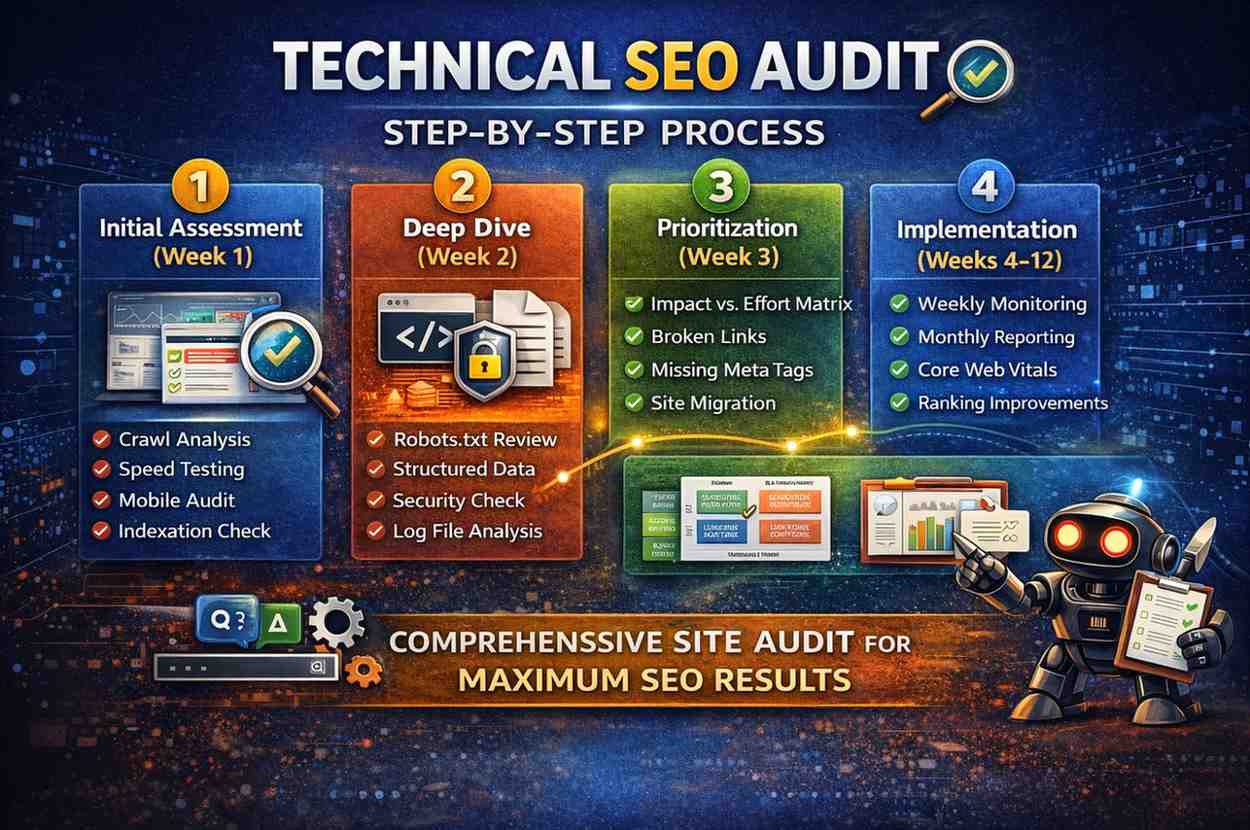
Phase 1: Initial Assessment (Week 1)
Crawl Analysis:
- Use Screaming Frog to crawl entire site
- Identify broken links (404s)
- Find redirect chains
- Locate orphaned pages
- Check for duplicate content
Speed Testing:
- Test 10-15 key pages with PageSpeed Insights
- Analyze Core Web Vitals
- Identify largest performance issues
- Check mobile vs. desktop speeds
Mobile Audit:
- Test with Mobile-Friendly Test
- Check mobile usability in Search Console
- Test on real devices (Android, iOS)
- Verify responsive design
Indexation Check:
site:niteshbaidya.com.np
Compare number of indexed pages vs. actual important pages.
Phase 2: Deep Dive (Week 2)
Robots.txt Review:
- Check for accidental blocks
- Verify sitemap reference
- Test with robots.txt Tester
Structured Data:
- Validate existing schema with Rich Results Test
- Identify missing schema opportunities
- Check for schema errors
Security Check:
- Verify HTTPS implementation
- Check for mixed content
- Test SSL certificate validity
- Scan for malware
Log File Analysis:
- Analyze 30 days of server logs
- Identify crawl budget issues
- Find pages Google never crawls
Phase 3: Prioritization (Week 3)
Impact vs. Effort Matrix:
High Impact, Low Effort (Fix First):
- Broken internal links
- Missing meta tags
- Image optimization
- Basic schema implementation
High Impact, High Effort:
- Site migration to HTTPS
- Complete site restructure
- JavaScript rendering issues
- International targeting setup
Low Impact, Low Effort (Quick Wins):
- Optimize robots.txt
- Fix minor redirect chains
- Add missing alt text
Low Impact, High Effort (Deprioritize):
- Perfect URL structure on old posts
- Obsessing over minor speed improvements
- Over-optimization of low-traffic pages
Phase 4: Implementation (Weeks 4-12)
Execute fixes based on priority, monitoring impact continuously.
Weekly Monitoring:
- Google Search Console errors
- Core Web Vitals scores
- Indexed pages count
- Crawl stats
Monthly Reporting:
- Technical health score
- Organic traffic trends
- Ranking improvements
- Issue resolution progress
Technical SEO Tools for Nepal Businesses
Free Tools
- Coverage reports (indexing issues)
- Core Web Vitals
- Mobile usability
- Security issues
- Manual actions
- Performance scores
- Core Web Vitals data
- Optimization suggestions
- Mobile and desktop analysis
Google Mobile-Friendly Test:
- Mobile compatibility check
- Rendering preview
- Mobile usability issues
- Schema validation
- Rich snippet preview
- Error identification
Chrome DevTools:
- Network analysis
- JavaScript debugging
- Performance profiling
- Mobile device emulation
Paid Tools (Worth the Investment)
Screaming Frog SEO Spider (Free up to 500 URLs):
- Comprehensive site crawl
- Broken link detection
- Duplicate content finder
- XML sitemap generation
- Cost: Free (limited) or £149/year
Ahrefs:
- Site audit tool
- Backlink analysis
- Rank tracking
- Competitor analysis
- Cost: $99-$999/month
SEMrush:
- Technical SEO audit
- Position tracking
- Competitor research
- Content analysis
- Cost: $119.95-$449.95/month
GTmetrix:
- Detailed speed analysis
- Performance recommendations
- Historical data
- Multiple location testing
- Cost: Free (limited) or $14.95-$99.95/month
Nepal-Specific Considerations
Hosting Recommendations:
- Choose Nepal-based hosting for local sites
- Consider CDN for international audience
- Ensure 99.9% uptime guarantee
- Check server location impact on speed
Internet Speed Context:
- Average mobile speed in Nepal: 10-15 Mbps
- Optimize aggressively for mobile
- Test with slower connection speeds
- Prioritize above-the-fold content
Common Technical SEO Mistakes in Nepal
Mistake 1: Ignoring Mobile Experience
The Problem: Many Nepal businesses optimize for desktop, forgetting 85% of users are on mobile.
The Fix:
- Mobile-first design approach
- Test on actual devices
- Optimize images for mobile
- Simplify navigation
Mistake 2: Cheap Hosting
The Problem: Saving NPR 500/month on hosting costs thousands in lost revenue.
The Fix:
- Invest in quality hosting (NPR 2,000-5,000/month)
- Choose servers near target audience
- Ensure adequate resources
- Monitor uptime continuously
Mistake 3: Unoptimized Images
The Problem: 5MB images uploaded directly from cameras destroy load times.
The Fix:
- Resize images to display dimensions
- Compress with tools like TinyPNG
- Use WebP format
- Implement lazy loading
Mistake 4: No XML Sitemap
The Problem: Google struggles to discover all your pages.
The Fix:
- Generate XML sitemap
- Submit to Search Console
- Update automatically
- Include only important pages
Mistake 5: Duplicate Content
The Problem: Same content on multiple URLs confuses Google.
The Fix:
- Implement canonical tags
- Use 301 redirects
- Consolidate similar pages
- Create unique content
Mistake 6: Broken Links
The Problem: 404 errors damage user experience and waste crawl budget.
The Fix:
- Regular link audits (monthly)
- Fix or redirect broken links
- Monitor 404 reports in Search Console
- Set up custom 404 page
Mistake 7: No HTTPS
The Problem: Security warning scares users away; ranking penalty applies.
The Fix:
- Install SSL certificate immediately
- Redirect all HTTP to HTTPS
- Fix mixed content warnings
- Update all resources
Technical SEO for Different Industries in Nepal
E-commerce Technical SEO
Specific Challenges:
- Thousands of product pages
- Faceted navigation (filters)
- Product availability changes
- Duplicate product descriptions
Solutions:
- Implement product schema markup
- Handle facets properly (canonical/noindex)
- Optimize category structure
- Create unique product descriptions
- Use breadcrumbs
- Implement product reviews schema
Service Business Technical SEO
Focus Areas:
- Local business schema
- Service area pages
- Contact information consistency
- Review schema
- Fast loading (build trust)
Publishing/News Sites
Priorities:
- Article schema markup
- News sitemap
- AMP implementation (optional)
- Fast publishing workflow
- Infinite scroll optimization
Tourism/Trekking Sites
Key Elements:
- Rich media optimization (images/videos)
- Location-based pages
- Multi-language support
- Booking system integration
- Tour package schema
Measuring Technical SEO Success
Key Performance Indicators (KPIs)
Technical Health Metrics:
- Crawl error count (target: 0)
- Indexed pages percentage (target: 95%+)
- Core Web Vitals pass rate (target: 90%+)
- Mobile usability errors (target: 0)
- HTTPS coverage (target: 100%)
Performance Metrics:
- Average page load time (target: <3 seconds)
- LCP score (target: <2.5 seconds)
- FID score (target: <100ms)
- CLS score (target: <0.1)
- Mobile PageSpeed score (target: 90+)
Business Impact Metrics:
- Organic traffic growth
- Search visibility increase
- Bounce rate decrease
- Conversion rate improvement
- Page depth (pages per session)
Tracking Tools
Google Analytics 4:
- Site speed reports
- User flow analysis
- Conversion tracking
- Behavior metrics
Google Search Console:
- Coverage reports
- Performance data
- Core Web Vitals
- Mobile usability
Custom Dashboards: Create monthly technical SEO dashboard showing:
- Technical issues fixed
- Speed improvements
- Indexation changes
- Organic traffic impact
- Ranking improvements
Technical SEO Pricing in Nepal
Investment Levels
DIY Approach:
- Cost: Time investment + tools (NPR 0-10,000/month)
- Best for: Very small sites, technical founders
- Limitation: Requires technical knowledge, time-consuming
Freelance Technical SEO:
- Cost: NPR 20,000-50,000/month
- Best for: Small to medium sites
- Includes: Audits, prioritized fixes, monthly monitoring
- Limitation: Limited bandwidth for large sites
Agency Services:
- Cost: NPR 50,000-150,000+/month
- Best for: Large sites, e-commerce, enterprise
- Includes: Full team, comprehensive fixes, ongoing optimization
- Benefits: Expertise, resources, accountability
One-Time Technical Audit
Basic Audit:
- Cost: NPR 15,000-30,000
- Includes: Crawl analysis, speed test, basic recommendations
- Timeline: 1 week
Comprehensive Audit:
- Cost: NPR 50,000-100,000
- Includes: Deep analysis, prioritized roadmap, implementation guidance
- Timeline: 2-3 weeks
What’s Included:
- Complete site crawl analysis
- Speed and Core Web Vitals assessment
- Mobile usability review
- Security check
- Schema audit
- Prioritized action plan
- 30-day support for implementation questions
ROI Expectations
Timeline:
- Initial improvements: 2-4 weeks
- Significant impact: 2-3 months
- Full results: 4-6 months
Typical ROI:
- 3-5x return within 6 months
- Ongoing compounding benefits
- Improved user experience
- Lower acquisition costs
- Higher conversion rates
Real Example: A Kathmandu e-commerce site invested NPR 80,000 in technical SEO fixes. Within 5 months:
- Organic traffic: +340%
- Page speed: 8.2s → 2.1s
- Conversion rate: +180%
- Additional revenue: NPR 310,000/month
- ROI: 387% in 5 months
Your Technical SEO Action Plan
Month 1: Foundation
Week 1:
- [ ] Install Google Search Console
- [ ] Add Google Analytics 4
- [ ] Run Screaming Frog crawl
- [ ] Test site speed with PageSpeed Insights
- [ ] Check mobile-friendliness
Week 2:
- [ ] Fix critical crawl errors
- [ ] Resolve broken links (404s)
- [ ] Implement HTTPS (if not done)
- [ ] Create/update XML sitemap
- [ ] Submit sitemap to Search Console
Week 3:
- [ ] Optimize robots.txt
- [ ] Add basic schema markup (Local Business)
- [ ] Fix duplicate content issues
- [ ] Implement canonical tags
- [ ] Set up 301 redirects for old URLs
Week 4:
- [ ] Compress all images
- [ ] Enable browser caching
- [ ] Minify CSS/JavaScript
- [ ] Implement lazy loading
- [ ] Test Core Web Vitals again
Month 2: Optimization
Week 5-6:
- [ ] Optimize site architecture
- [ ] Improve internal linking
- [ ] Add breadcrumbs
- [ ] Create category/location pages
- [ ] Optimize URL structure
Week 7-8:
- [ ] Add advanced schema (Article, FAQ, Product)
- [ ] Optimize for mobile (touch targets, font sizes)
- [ ] Improve server response time
- [ ] Set up CDN if targeting international
- [ ] Implement structured data testing
Month 3: Monitoring & Refinement
Week 9-10:
- [ ] Analyze Search Console data
- [ ] Review Core Web Vitals trends
- [ ] Fix new issues that appeared
- [ ] Optimize underperforming pages
- [ ] Track ranking improvements
Week 11-12:
- [ ] Conduct follow-up technical audit
- [ ] Document improvements
- [ ] Create ongoing monitoring schedule
- [ ] Set up automated alerts
- [ ] Plan next quarter priorities
Ongoing: Maintenance
Weekly:
- Check Search Console for new errors
- Monitor site speed
- Review analytics for anomalies
Monthly:
- Full technical health check
- Core Web Vitals assessment
- Security scan
- Broken link check
Quarterly:
- Comprehensive technical audit
- Competitive analysis
- Strategy adjustment
- Tool/plugin updates
Why Choose Nitesh Baidya for Technical SEO Services
✅ Technical Expertise
I don’t just identify issues—I fix them. With deep technical knowledge spanning server configuration, code optimization, and search engine algorithms, I solve problems others only describe.
✅ Nepal-Specific Understanding
I understand Nepal’s unique challenges: slower internet speeds, mobile-first users, local hosting considerations, and budget constraints. My solutions work in Nepal’s real-world conditions.
✅ Proven Results
My technical SEO work has helped businesses across Nepal:
-
-
-
-
- Reduce page load times by 70%+ on average
- Achieve 95%+ indexation rates
- Improve Core Web Vitals scores from red to green
- Recover from Google penalties
- Fix complex crawl and index issues
-
-
-
✅ Transparent Communication
You receive clear explanations of technical issues in plain language, not jargon. Detailed monthly reports show exactly what was fixed and the impact on your rankings and traffic.
✅ Comprehensive Approach
Technical SEO doesn’t exist in isolation. I coordinate technical fixes with content strategy, link building, and conversion optimization for maximum impact.
✅ Long-Term Partnership
Technical SEO is ongoing, not one-time. I provide continuous monitoring, proactive fixes, and strategy adjustments as search engines evolve and your site grows.
Conclusion: Build Your Technical Foundation Today
Technical SEO is invisible to users but essential for success. While your competitors pour money into content and advertising, technical issues silently sabotage their efforts. You can’t outrank sites with superior technical foundations, no matter how much money you spend on content or backlinks.
The businesses dominating search results in Nepal aren’t necessarily creating the best content—they’re the ones who fixed technical barriers first. They load fast, work perfectly on mobile, help search engines understand their content, and provide excellent user experiences.
Your website’s technical health directly impacts every rupee spent on marketing. Fix technical issues first, and every subsequent marketing effort works better. Content ranks higher. Paid traffic converts better. Email marketing drives more engagement. Social media traffic sticks around.
Your Next Step
Technical SEO seems overwhelming because it touches every aspect of your website. You don’t need to fix everything immediately—you need a strategic approach prioritizing high-impact fixes.
Ready to transform your website’s technical performance?
I offer comprehensive technical SEO services tailored to Nepal-based businesses:
-
-
-
-
- Complete technical audit with prioritized action plan
- Critical issue resolution (speed, mobile, indexing)
- Ongoing monitoring and optimization
- Core Web Vitals improvement
- Schema markup implementation
- Recovery from technical penalties
-
-
-
Let’s audit your site for free. Contact me today for a no-obligation technical SEO consultation. I’ll identify your top 3 technical issues and show you exactly how to fix them.
📞 Call: +977-9818209722 📧 Email: contact@niteshbaidya.com.np 💬 WhatsApp: +977-9818209722 Don’t let technical issues hold your business back. Every day you wait is another day your competitors gain advantage.
Frequently Asked Questions About Technical SEO
Q1. What is the difference between technical SEO and regular SEO?
Ans: Technical SEO focuses on website infrastructure, performance, and crawlability—how search engines access and process your site. Regular SEO (on-page SEO) focuses on content quality, keywords, and relevance. Both are essential: technical SEO ensures search engines can reach your content, while on-page SEO ensures that content is valuable and relevant.
Q2. How long does it take to see results from technical SEO?
Ans: Initial improvements appear within 2-4 weeks as Google recrawls your fixed pages. Significant traffic and ranking improvements typically show within 2-3 months. Complex issues requiring extensive fixes may take 4-6 months for full impact. Unlike content or backlinks, technical fixes often produce faster initial results because you’re removing barriers immediately.
Q3. Can I do technical SEO myself?
Ans: Yes, if you have technical knowledge and time. Basic technical SEO (fixing broken links, optimizing images, adding sitemaps) is manageable for motivated business owners. However, complex issues (JavaScript rendering, server configuration, large-scale migrations) benefit from professional expertise. Consider your time value versus hiring cost.
Q4. How much does technical SEO cost in Nepal?
Ans: One-time audits range from NPR 15,000-100,000 depending on site complexity. Ongoing technical SEO services cost NPR 20,000-150,000/month. Investment depends on site size, technical complexity, and current issues. Most businesses see 3-5x ROI within 6 months, making technical SEO one of the highest-return marketing investments.
Q5. What are Core Web Vitals and why do they matter?
Ans: Core Web Vitals are Google’s standardized metrics measuring user experience: loading speed (LCP), interactivity (FID/INP), and visual stability (CLS). They matter because they’re confirmed ranking factors and directly impact user experience. Sites with poor Core Web Vitals lose 53% of mobile visitors and rank lower in search results.
Q6. Will fixing technical issues guarantee higher rankings?
Ans: Technical SEO removes barriers preventing your site from ranking well—it’s necessary but not sufficient. Think of it as clearing obstacles from a race track. Your content, backlinks, and relevance still determine how fast you run, but technical issues ensure you’re not stuck at the starting line. Combined with quality content and authority, technical fixes produce dramatic ranking improvements.
Q7. How often should I conduct a technical SEO audit?
Ans: Conduct comprehensive audits quarterly for most sites. Run quick health checks monthly using Google Search Console. After major site changes (redesign, migration, platform change), audit immediately. E-commerce sites adding hundreds of products monthly benefit from monthly monitoring. Small static sites can audit semi-annually.
Q8. What’s the most important technical SEO factor?
Ans: There’s no single most important factor—technical SEO is a system where multiple elements work together. However, if forced to choose, site speed (especially mobile) has the broadest impact on both rankings and user experience. A fast, mobile-friendly, secure (HTTPS) site with clean architecture forms the foundation for all other optimizations.
Q9. Can technical SEO fix a Google penalty?
Ans: Yes, many Google penalties result from technical issues: thin content, duplicate content, hacked sites, mobile usability problems. Technical SEO can identify and fix these issues, though recovery takes time (usually 2-4 months after fixes). Manual penalties require filing reconsideration requests. Algorithmic penalties lift automatically once issues are resolved.
Q10. Do I need technical SEO if my site is new?
Ans: Absolutely—even more so. Building technical foundations correctly from the start prevents costly fixes later. New sites should implement proper structure, schema markup, mobile optimization, and speed optimization immediately. It’s far easier to build correctly initially than to fix problems after launching with hundreds of pages and established traffic patterns.
Q11. What tools do I need for technical SEO?
Ans: Essential free tools: Google Search Console, PageSpeed Insights, Mobile-Friendly Test, Chrome DevTools. Helpful paid tools: Screaming Frog (crawling), Ahrefs or SEMrush (comprehensive audits). Most technical SEO can be done with free tools, though paid tools save significant time for professionals managing multiple sites or large websites.
Q12. How does technical SEO differ for mobile vs. desktop?
Ans: With mobile-first indexing, Google primarily uses your mobile site for ranking and indexing. Technical SEO for mobile emphasizes page speed (3G connections), touch-friendly interface (tap targets), simplified navigation, and aggressive image optimization. While desktop experience still matters for users, mobile technical performance directly impacts rankings for all devices.